
TL;DR
- Your real risk in China is verification, not the OEM-vs-ODM decision. Most suppliers who call themselves a “factory” are trading companies, and most disputes are about who is accountable when mass production drifts from the sample (Jingsourcing, 7 Ways to Verify Chinese Suppliers, 2026).
- Certification is a market-specific stack: FCC ID (US), CE under the RED (EU), UKCA (UK), a Bluetooth SIG listing, plus RoHS and REACH. A real factory hands you the actual IDs, not a spoken “yes, we’re certified” (Blue Maestro, Bluetooth Device Compliance, 2026; trade.gov, CE Marking).
- Treat any “medical,” “clinical,” or “diagnoses” sensor copy as a liability transfer. The FDA’s General Wellness policy draws the line between an unregulated wellness product and a regulated medical device (FDA General Wellness guidance, via Elexes, 2026).
- Use the 12-point checklist below before you wire tooling money. Each point pairs a criterion with the question to ask, the red flag to watch, and the evidence to request.
Why Smart Ring Buyers Get Burned
Most sourcing deals don’t fail on price. They fail on accountability.
Four patterns show up again and again. First, a trading company poses as a factory, takes the order, and disappears behind an email address when something breaks. Registered capital and a polished Alibaba page prove nothing here (Jingsourcing, 2026). Second, the sample is flawless and the mass-production run isn’t; yield and unit-to-unit consistency drop once volume starts, and nobody wrote down an AQL. Third, the certification stack is incomplete, so the product can’t clear customs or a retail buyer’s compliance check. Fourth, the supplier’s own marketing over-claims on health, and that claim becomes your legal exposure the moment you put your brand on the box.
One point drives the rest of this piece: picking OEM or ODM is a 20-minute conversation, but verifying a factory is what saves or costs you money. The checklist below defends against those four failure modes, one point at a time. Print it, and take it to every supplier on your shortlist, including us.
| Failure mode | What it costs you | Defended by |
|---|---|---|
| Trader posing as factory | No accountability on defects/rework | Points 1, 3 |
| Great sample, weak mass production | Yield loss, missed launch dates | Points 11, 5 |
| Incomplete certifications | Blocked at customs or retail intake | Points 4, 6 |
| Health-claim over-reach | Legal liability transferred to your brand | Points 6, 5 |
The 12-Point Smart Ring Manufacturer Checklist
Use it like a scorecard. For each point, ask the question, watch for the red flag, and don’t move forward until you hold the evidence. If a supplier balks at handing over evidence a real factory keeps on file, that’s your answer.
| # | Criterion | Ask for | Red flag | Evidence to request |
|---|---|---|---|---|
| 1 | Real factory vs trader | Business license + live factory video | Only capital boasts, no VAT invoice | Business license (营业执照), general-taxpayer status, audit |
| 2 | OEM vs ODM fit | Which model fits your maturity | Pushes one model regardless | References for both paths |
| 3 | Product-line breadth | Models in production, by category | Single SKU / dropship catalog | Current model list, in-house lines |
| 4 | Certification stack | FCC ID, SIG Declaration ID, CE/RED, RoHS | ”We’re certified,” no IDs | Real IDs + Declaration of Conformity + test reports |
| 5 | Sensor accuracy evidence | Sensor part number + validation | ”Medical-grade” with no data | Part number, reference method, any validation report |
| 6 | Health-claim compliance | Wellness-bounded language | Volunteers “diagnoses/cures” copy | Source-bound claim wording |
| 7 | App / SDK / white-label | Own-brand app + SDK access | Locked to supplier’s app | White-label terms, SDK docs, app-ownership clause |
| 8 | Data ownership / GDPR | Controller/processor + residency | Assumes zero responsibility | Data-processing agreement |
| 9 | IP / NDA / mold ownership | Signed NDA + who owns the mold | Refuses NDA, vague on tooling | NDA, written mold-ownership clause |
| 10 | MOQ / tooling / cost | Itemized quote, all tiers | Vague pricing, hidden tooling | Written quote: MOQ tiers, tooling, sample fee |
| 11 | Lead time + QC | Written lead time + AQL | No QC plan behind the sample | Lead time, QC/AQL plan, inspection reports |
| 12 | After-sales / firmware | Warranty, RMA, OTA path | No post-sale support | Warranty terms, RMA SLA, firmware roadmap |
Is It a Real Factory, and the Right Fit? (Points 1–3)
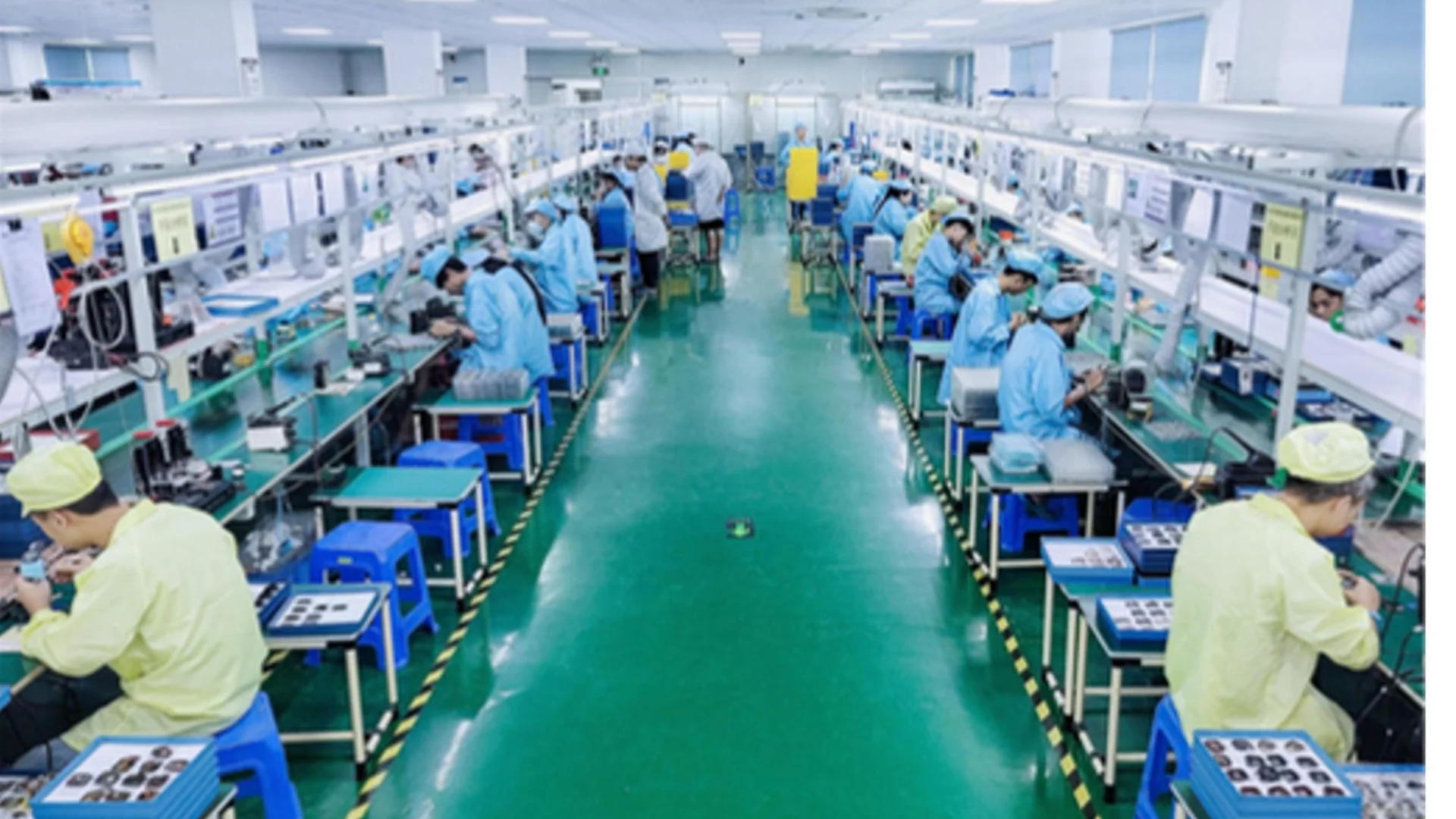
Point 1. Real factory vs trading company. Start here, because everything downstream depends on it. Ask the supplier to send their business license (营业执照) and read the business scope; wording like “manufacturing, processing, assembly” points to a factory, and general-taxpayer VAT status backs it up (Jingsourcing, 2026). Then ask for a live factory walk-through on video. Do not judge by registered capital. A small factory can register under ¥500,000 while a large trader clears ¥10M, so the number tells you nothing (Jingsourcing, 2026). A real manufacturer treats these requests as routine; on request, Yawell can show the SHENZHEN YAWELL INTELLIGENT TECHNOLOGY business license and a line walk-through.
Point 2. OEM vs ODM fit. OEM means the factory builds to your design; ODM means you brand the factory’s design. Neither is inherently better. If you have engineering to spend and a differentiated design, OEM gives you control. If you want speed and a proven platform, ODM gets you there faster. Watch for a supplier who pushes one model regardless of your project; that choice serves their workflow, not yours. For how Yawell structures those paths, see the smart ring OEM/ODM service page.
Point 3. Product-line breadth and in-production capacity. Ask how many models they currently have in production, and in which categories. A supplier with one SKU and a broad “catalog” of other people’s products is usually a trader reselling. A real factory carries several live lines; Yawell runs 12 models in production across three categories: six smart rings (R02, R04S, R08, R10, R12 Ceramic, R20), five smart bands, and one pair of smart glasses. That breadth is evidence that tooling, assembly, and QC already run in-house.
Will It Pass Compliance, Sensors, and Data? (Points 4–8)
Point 4. The certification stack. Verbal assurances mean nothing here. A Bluetooth smart ring bound for the US and EU needs an FCC ID (US), CE conformity under the Radio Equipment Directive (EU), UKCA (UK), and a Bluetooth SIG listing, plus RoHS and REACH declarations for the EU (Blue Maestro, 2026; trade.gov, CE Marking; Nortech, RoHS and REACH). Ask for the actual FCC ID and Bluetooth SIG Declaration ID for the exact model, then verify them yourself on fcc.gov and bluetooth.com. A factory that has shipped to your market produces these in minutes; a trader stalls. Yawell provides model-specific IDs and Declarations of Conformity on request.
Point 5. Sensor accuracy evidence. Consumer wearable sensors (PPG heart rate, SpO2, sleep staging) are not clinically validated by default, and reviews document real validation gaps for consumer devices (ResearchGate, Clinical Validation Challenges for Consumer Wearables, 2025). So don’t accept “accurate” as an adjective. Ask for the sensor part number, the reference method, and any validation report. Treat an unqualified “medical-grade accuracy” claim with nothing behind it as a warning sign. Honest limits are a good sign.
Point 6. Health-claim compliance. The FDA’s General Wellness policy separates a wellness product, one meant to maintain or encourage a general state of health, from a regulated medical device, and it turns on disease claims: diagnosis, cure, mitigation, prevention, or treatment (FDA General Wellness guidance, via Elexes, 2026). If a supplier volunteers “diagnoses hypertension” or “clinically proven” copy, that claim becomes your regulatory risk the moment your brand ships it. Keep every health claim wellness-bounded and source-bound to the spec sheet.
Point 7. App, SDK, and white-label rights. Decide who owns the software before you sign. Ask whether you get a white-labeled app under your own developer account, whether you get SDK access to the device data, and who publishes the app in the stores. Watch for a ring that only talks to the supplier’s branded app with no SDK. That locks your users and your data inside someone else’s product.
Point 8. Data ownership and GDPR. Under GDPR, whoever decides the purposes and means of processing personal data is the data controller and carries the legal responsibility (GDPR Art. 24, gdpr-info.eu; EDPB controller/processor guide). Health and wellness data is a sensitive category, so the handling bar is higher. For EU users, settle who is controller and who is processor, and where the data resides, in a written data-processing agreement, not a handshake.
Can It Deliver, Protect IP, and Support You? (Points 9–12)
Point 9. IP protection, NDA, and mold ownership. Ask two questions early: will you sign an NDA, and who owns the tooling and mold once I pay for it? Watch for a supplier who refuses an NDA or stays vague on mold ownership. Get mold ownership in writing before any tooling payment, or the tooling you funded can end up running a competitor’s order.
Point 10. MOQ, tooling, and cost transparency. Get an itemized written quote: MOQ tiers, tooling or mold fee, sample fee, and unit price at each tier. Vendor pages float typical figures, such as standard OEM MOQs around 500–1,000 pieces per model, with samples in days and mass production in weeks, but these are marketing ranges, not a benchmark you can hold anyone to (Goodway Techs; GY Smartwatch, vendor-stated). Treat any number as illustration until it sits in a project-specific written quote with your name on it. Hidden tooling costs that surface after the deposit are the classic way a “cheap” quote turns expensive.
Point 11. Lead time and sample-to-mass-production consistency. A good sample proves little about the production run. Ask for the written lead time and, more important, the QC plan and AQL that govern the gap between the sample and the 5,000th unit. Signing off on a sample with no inspection protocol behind it is the common mistake. Yield and consistency are where thin margins disappear. Request inspection reports and an AQL you both agree on, in writing.
Point 12. After-sales, warranty, and firmware. A smart ring is a software product on a hardware schedule. Ask about the warranty term, the RMA process and its turnaround, and the firmware-update commitment, including whether over-the-air updates are supported. No post-sale support and no OTA path means every field bug becomes a recall conversation. (Warranty and RMA norms vary by supplier; treat this as a best-practice ask, not a fixed standard.)
Certification Map and the Cost/Time Reality
Two tables settle most of the certification confusion.
The first maps each scheme to a market and to the evidence you should demand. A “CE sticker” self-applied by the supplier is not proof of radio testing; the FCC ID and the Declaration of Conformity are (Blue Maestro, 2026).
| Scheme | Market | What it proves | Evidence to request |
|---|---|---|---|
| FCC ID | USA | Intentional-radiator RF conformity | FCC ID number (verify on fcc.gov) |
| CE / RED | EU | Radio Equipment Directive conformity | EU Declaration of Conformity + test reports |
| UKCA | UK | UK conformity | UKCA declaration |
| Bluetooth SIG | Global (trademark) | Qualified/declared Bluetooth design | Declaration ID / QDID |
| RoHS | EU | Hazardous-substance restriction | RoHS declaration + test report |
| REACH | EU | Chemical-substance compliance | REACH statement |
The second explains why a real factory can move fast on certification: it usually builds on pre-certified modules. Using a pre-certified Bluetooth module lets a product reference the module’s FCC ID and file a Bluetooth SIG Declaration, which one vendor guide puts around $500–2,000 and two to four weeks; a full custom-hardware certification with accredited-lab RF testing and a full SIG Qualification runs an order of magnitude higher, roughly $15,000–50,000+ and eight to sixteen weeks (Blue Maestro, 2026, vendor-stated). Read these as orders of magnitude, not quotes.
| Path | Requirements | Typical cost (USD) | Timeline |
|---|---|---|---|
| Pre-certified module | Reference module FCC ID; SIG Declaration; no extra RF test | 500–2,000 | 2–4 weeks |
| Full custom certification | Accredited-lab RF test; FCC ID; full SIG Qualification | 15,000–50,000+ | 8–16 weeks |
If a supplier quotes months and five figures for certification on a standard module-based design, either the design isn’t as standard as they say, or they haven’t done it before.
OEM vs ODM, and Factory vs Trader
Resolve the two either/or choices with clear criteria.
OEM vs ODM:
| Dimension | OEM (your design) | ODM (their design) |
|---|---|---|
| Design control | High | Lower |
| Time to market | Slower | Faster |
| Upfront tooling | Higher | Lower/shared |
| Differentiation | Strong | Limited |
| Best when | You have engineering + a distinct product | You want speed on a proven platform |
Factory vs trading company:
| Signal | Real factory | Trading company |
|---|---|---|
| Business license scope | Manufacturing/processing/assembly | Trade/wholesale wording |
| VAT status | General taxpayer, issues VAT invoice | Often cannot |
| Product lines | Several in-house lines | Single SKU or broad resale catalog |
| Certification IDs | Provides FCC ID / SIG Declaration ID | Stalls or forwards someone else’s |
| Factory audit | Welcomes live video / third-party audit | Avoids it |
Source: Jingsourcing (2026); ChineseCheck (2026); product-line breadth as a factory signal.
Non-Negotiables Before You Wire Tooling Money
Fail any one of these, and walk away.
- Verifiable proof the supplier is a real factory: license scope, VAT status, and a live audit (Point 1).
- The actual FCC ID and Bluetooth SIG Declaration ID for your exact model and markets, verified by you (Point 4).
- A signed NDA and written mold ownership before any tooling payment (Point 9).
- Wellness-bounded, non-medical claim language you both agree to in writing (Point 6).
- An itemized written quote and a QC/AQL plan, not a verbal price and a single sample (Points 10, 11).
Common Mistakes Buyers Make
| Mistake | The fix |
|---|---|
| Trusting registered capital as a factory signal | Read the license scope; confirm VAT/general-taxpayer status |
| Accepting “certified” without IDs | Demand FCC ID + SIG Declaration ID; verify them yourself |
| Approving a sample with no QC/AQL | Get the inspection protocol and AQL in writing |
| Letting “medical” copy stand | Bind all health claims to the spec sheet, wellness-only |
| Paying tooling before mold ownership is set | Sign mold ownership before the deposit |
FAQ
1. How do I tell a real smart ring factory from a trading company?
Check the business license scope, confirm general-taxpayer VAT status, count how many models they run in-house, and ask for a live factory video. Registered capital is not a reliable signal: small factories can register low and large traders can register high (Jingsourcing, 2026).
2. What is the difference between OEM and ODM for smart rings?
OEM means the manufacturer builds to your own design and specification; ODM means you brand the manufacturer’s existing design. OEM gives more control and slower time-to-market; ODM is faster on a proven platform with lower upfront tooling.
3. What certifications does a smart ring need for the US and EU?
For a Bluetooth ring: FCC ID (US), CE under the Radio Equipment Directive (EU), UKCA (UK), a Bluetooth SIG listing, and RoHS/REACH for the EU (Blue Maestro, 2026; trade.gov, CE Marking; Nortech, RoHS and REACH). Ask for the actual IDs and the Declaration of Conformity, then verify them on fcc.gov and bluetooth.com.
4. What is a typical MOQ and lead time for a custom smart ring?
Vendor pages cite standard OEM MOQs around 500–1,000 pieces per model, samples in days, and mass production in weeks (Goodway Techs; GY Smartwatch, vendor-stated). Treat these as illustrative ranges only. Get MOQ tiers, tooling fee, and lead time in a project-specific written quote before you rely on any number.
5. Can I use my own app and own the user data?
Ask for a white-labeled app under your developer account, SDK access to device data, and a clear app-ownership clause. For EU users, GDPR makes whoever decides how personal data is processed the controller, with legal responsibility, so settle controller/processor roles and data residency in a written agreement (GDPR Art. 24, gdpr-info.eu).
6. Are smart ring heart-rate, SpO2, and sleep sensors accurate?
Consumer wearable sensors are not clinically validated by default, and validation gaps for consumer devices are documented (ResearchGate, 2025). Ask for the sensor part number, the reference method, and any validation report. Be wary of “medical-grade” claims, which can pull a product into medical-device regulation (FDA General Wellness guidance, via Elexes, 2026).
7. Do OEM smart rings support iOS and Android equally?
Most do, through the companion app and SDK, but parity isn’t automatic. Ask for the supported OS versions and confirm the SDK covers both platforms before you commit. Treat this as a spec to verify.
Turn the Checklist Into a Shortlist
The lesson underneath all twelve points is one line: verification beats model choice. A supplier who can hand you a business license, real certification IDs, a signed NDA, and a written QC plan has already told you more than any brochure will.
So put the list to work. Send these 12 questions to every supplier on your shortlist, including us, and ask for a quote alongside the matching sample, certifications, and spec sheet. The suppliers who answer with documents rather than adjectives are worth your tooling money.
Put the checklist to work with us. Request a quote (RFQ) and we’ll respond with the samples, certifications, and specs that match your project. You can also review the smart ring OEM/ODM service page, our factory and capabilities, the smart ring product line, or model pages such as R02 and R12 Ceramic.