
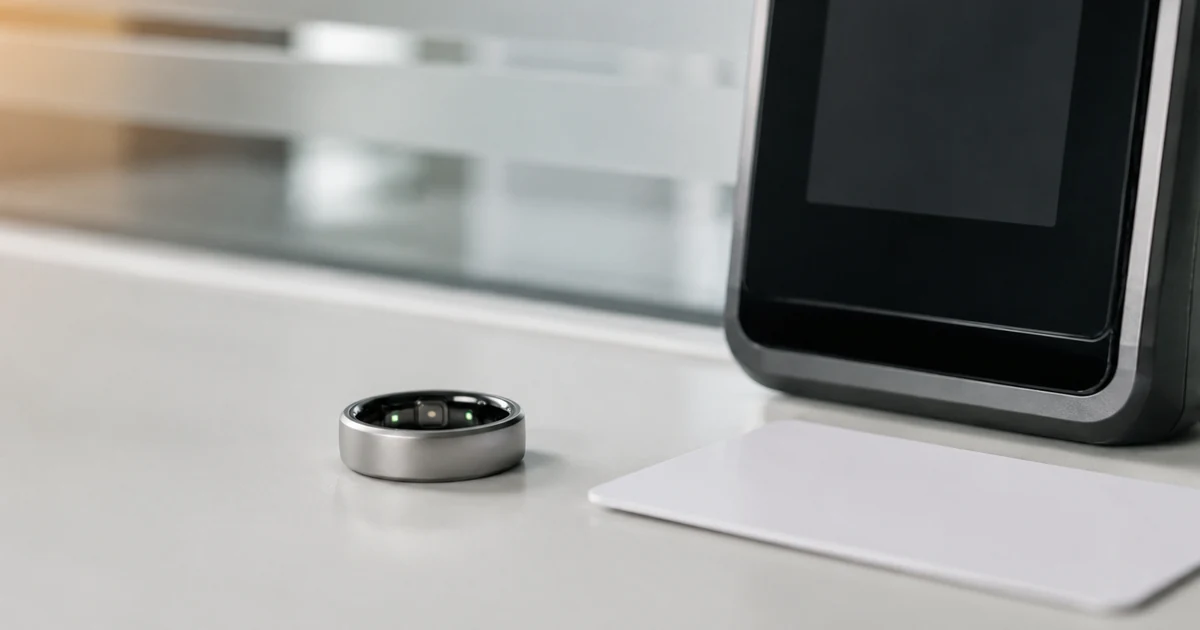
A brand owner asks a factory to add NFC to a smart ring and expects a component quote. What comes back depends entirely on which kind of NFC ring they meant, and most buyers have not decided. The phrase covers a passive tag worth a few cents, a corporate door credential, a transit card, and a contactless payment device that needs approvals a factory cannot obtain on its own. This guide separates those four products, explains what each one commits you to, and gives you the questions that tell you whether a supplier has built one before.
TL;DR
- “NFC smart ring” describes four different products separated by certification burden, not by component cost.
- A battery-free ring cannot emulate a card in software, so any credential of consequence needs a hardware secure element chosen at design time.
- Open-loop payment requires an EMVCo approval path, a token service provider and an issuing bank. No manufacturer can grant payment capability alone.
- Most brands get the outcome they actually want from the access control tier at a fraction of the cost.
- Ring body material changes NFC antenna behaviour, so material and NFC are one decision.
Four products share one name
Sort NFC rings by how much approval work stands between the design and the shelf, and four tiers appear.
| Tier | Typical use | Silicon | Partners beyond the factory | Approval work |
|---|---|---|---|---|
| Passive NFC tag | Share a URL or contact card, trigger a phone automation | NTAG-class tag chip, no secure element | None | Regional radio compliance only |
| Access credential | Office door, campus card, gym entry | Secure contactless IC such as DESFire EV3, or a platform-specific credential IC | Credential platform vendor, site access control integrator | Radio compliance, credential licensing, reader-side validation |
| Closed-loop or transit | Campus stored value, venue or transit scheme | Secure IC with a key-managed application | Scheme operator and its key management authority | Radio compliance, scheme approval, key ceremony |
| Open-loop payment | Tap to pay anywhere contactless is accepted | Certified payment secure element running a payment operating system | Token service provider or wearable payment enabler, issuing bank, card networks | Radio compliance, EMVCo functional approval and security evaluation, card network and issuer requirements |
The bottom tier is a component purchase. Adafruit sells an NFC ring built on an NTAG213 chip as a stock item, which tells you how commoditised that end of the market is. The top tier is a payments program that happens to be shaped like jewellery.
Name your tier before you request a quote. A supplier who hears “NFC ring” and quotes the tag tier will look cheap next to one who understood you meant payment, and you will not find out why until the samples arrive.
Why a ring needs a secure element
NFC card emulation is normally handled by a dedicated chip called a secure element. Android’s documentation describes the mechanism plainly: the NFC controller routes all data from the reader directly to the secure element, the secure element performs the transaction itself, and no application takes part while it happens.
The alternative is host card emulation, which routes that data to the host CPU and runs the credential in software instead. It works on phones because a phone is a powered computer with an operating system running. A ring with no battery is neither. When the ring is presented to a reader, the reader’s field is the only power source and there is no host to run anything. That is why the credential has to live in silicon.
This makes NFC an early hardware decision rather than a firmware feature you can add in a later revision. Payment-grade silicon arrives as a package. STMicroelectronics combines an ST31 secure microcontroller, an STS3922 NFC booster and its STPay-Tiger payment operating system into one system-in-package aimed at exactly this use case.
Ask any supplier for the secure element part number and the operating system running on it. If nobody can name both, there is no certification behind the product, because certification attaches to that combination.
The access control tier, where most brands should stop
Access control delivers the thing buyers usually want, which is a ring that opens doors, without entering a payments program. It is also where the honest technical distinction lives.
Identification and authentication are different operations. Reading an NFC unique identifier tells a reader which token claims to be present, and that identifier is easy to spoof with inexpensive, easily obtained hardware. Authentication adds a cryptographic exchange that only the original token can satisfy. A ring sold on the strength of a copied UID is a convenience product with no security property, and that difference matters the moment the credential opens something a company cares about.
Real credential platforms authenticate. MIFARE DESFire EV3 runs on the ISO/IEC 14443 Type A interface at 13.56 MHz, uses AES-128 mutual authentication between card and reader, and holds Common Criteria certification at EAL5+. Each application on the chip can hold its own key set, so a door credential and a cashless payment application stay in separate security domains.
The commercial catch sits one layer above the silicon. ISO/IEC 14443 standardises the radio interface. It does not by itself make application commands, keys or credential formats work across every reader and backend. Your ring has to be enrolled into the credential system that already runs at the site, and the keys and licensing for that system usually come through the platform vendor rather than through the factory.
Get the target site’s reader model and credential platform named before anyone designs hardware. If your customer runs one platform and your ring carries another chip family, no amount of manufacturing quality closes that gap. The ring material comparison covers the physical side of the same decision.
What open-loop payment actually commits you to
EMVCo publishes the structure that a payment ring has to pass through, and reading it is the fastest way to calibrate the scope.
EMV Level 1 covers the communication protocols between the payment instrument and the acceptance device, including the mechanical, electrical and radio frequency interfaces. EMV Level 2 covers the software component, called the kernel or payment application, that holds the processing logic and data for the transaction. Both apply to your product.
EMVCo names the category your ring falls into. Its 2025 guide to approvals lists NFC-enabled mobile devices such as smartphones, tablets and smartwatches, “as well as other form factors such as rings and bands,” under mobile payment form factors, with dedicated Level 1 and Level 2 testing processes. Functional approvals combined with security evaluations for these products are together called Mobile Type Approval. A ring is not treated as a simplified case.
EMVCo also does not run the tests. Independent recognised laboratories do, using EMVCo-qualified test tools, and EMVCo administers the qualification of the laboratories, the tools and the auditors. EMVCo states that it does not mandate conformance with EMV specifications, while noting that other entities may require it. In practice the card networks and issuers are those other entities.
Above the approvals sits a commercial layer no factory owns. Somebody has to turn a card number into a network token and load it into your secure element, and somebody has to issue the card in the first place. Fidesmo operates as a Trusted Service Manager performing over-the-air personalisation and tokenisation, which is why STMicroelectronics pairs its payment silicon with them. Tappy Technologies describes itself as a Wearable Token Service Provider connecting brands to issuing banks around the world. DIGISEQ runs a comparable platform for provisioning card network tokens into wearables. Before these enablement platforms existed, manufacturers had to negotiate directly with financial institutions.
That produces one conclusion worth stating flatly. A factory cannot grant payment capability. It can build hardware that a certified stack runs on, and it can work alongside an enabler and an issuer who supply the rest. A supplier who says it handles payment end to end, and names neither the enabler nor the issuing partner, is telling you it has not completed this before.
No cost or schedule figures appear in this section on purpose. EMVCo publishes process, not price, and the fee structures of card networks and enablers are commercial. Any blog quoting a number for a payment ring program invented it.
Apple Pay, Tesla and the compatibility questions buyers ask
Two consumer expectations reach the sourcing conversation almost every time, and both need correcting before they become requirements.
Apple Pay is Apple’s own wallet running on the iPhone’s secure element. From iOS 18.1, third-party developers gained API access to that secure element for contactless transactions in selected regions, a change that followed legally binding commitments Apple made to the European Commission under the Digital Markets Act. That opened app access on the phone. It did not create a route for third-party hardware to join Apple Pay. A ring that pays does so on its own secure element, with a token provisioned by an enabler and a card issued by a bank, and the phone is not part of the transaction.
Tesla is a more interesting case because the third-party ring category is already large. Published research on the Tesla key card protocol shows the card authenticating to the vehicle with 256-bit elliptic curve cryptography on the NIST P-256 curve, using a challenge-response with a key derived through elliptic-curve Diffie-Hellman, and the vehicle requiring an ATS frame size indicator of at least 6, meaning 96 bytes. That is proper authentication, not a UID read. The same research was reimplemented as an open-source Java Card applet, and the accessory rings on the market build on that public work.
Price the consequences before tooling. A product resting on a reverse-engineered protocol has no vendor commitment behind it, so a vehicle firmware update can change behaviour with no notice and no support path, and the trademark and authorisation position is yours to assess with counsel rather than something the factory can warrant. Buyers who treat this as a hardware question discover the risk after inventory lands.
Treat every “works with” claim the same way. Ask which layer provides the compatibility, and who stands behind it.
The ring body fights your antenna
NFC works by inductive coupling at 13.56 MHz, typically within about 10 cm. That coupling is fragile around metal, which detunes the antenna and drains energy through eddy current losses.
A 2025 measurement study puts numbers on the effect. Testing a four-turn rectangular coil on FR4 substrate, researchers found that direct contact with a 1 cm aluminium plate shifted resonance from 13.56 MHz to 15.48 MHz and degraded matching. Inserting a 0.5 mm ferrite sheet between the antenna and the metal pulled resonance back to about 14.12 MHz and recovered more than 70 percent of the original performance. The test used a flat plate rather than a ring, so read the figures as the physics rather than as a ring specification. A titanium or stainless steel body imposes the same problem in a harder geometry.
The practical consequence is that material, size range and antenna tuning are a single decision. Every ring size is a different loop with a different area, so read performance can vary across a size run that shares one design. Ask how the antenna is tuned across sizes and what the read range is at the smallest and largest ones. The chipset and sensor guide covers how these constraints stack up against the rest of the internal volume.
Radio compliance is separate from everything above
Even a passive tag ring needs regional radio approval, and it is independent of any payment or credential approval you also pursue.
For the United States, NFC products are evaluated under FCC Part 15.225 with magnetic field strength measurement, plus spurious emission scans at the 27.12 MHz and 40.68 MHz harmonics. For Europe, ETSI EN 300 330 covers inductive loop measurement using large-loop and small-loop antenna methods, feeding the technical file under the Radio Equipment Directive. Canada uses RSS-210.
Confirm which markets a supplier will test for, on which exact hardware configuration, and who holds the resulting reports. One report is not global coverage, and a report belonging to a different model tells you nothing about yours.
What to ask before you commit
Approvals attach to specific product configurations rather than to suppliers. That single fact drives most of the diligence below.
| Question | Why it matters | Answer that should worry you |
|---|---|---|
| Which tier of NFC are we building, in your words? | Tier decides cost, partners and schedule more than any component choice | A generic reply that the ring supports NFC |
| Which secure element part number, and which payment or credential OS runs on it? | The secure element and its OS carry any certification | The part cannot be named, or only the main MCU is named |
| Who is the token service provider or credential platform, and do we contract with them or with you? | This layer is a separate commercial relationship the factory usually does not own | The supplier says it handles everything and names no partner |
| Which approvals exist today on the exact hardware you would ship us, and can we see the listing? | Approvals do not transfer between configurations | An approval belonging to a different model or to a component vendor |
| Does changing the body material or size range require re-tuning and re-testing the antenna? | Metal shifts NFC resonance, and each size is a different loop | A claim that material and size have no effect |
| Which markets will you test for, and who holds the test reports? | FCC, RED and other regimes each need their own evidence | One report offered as global coverage |
Run the same discipline over the software side. Data handling, SDK access and account ownership deserve the treatment set out in the app customization guide, because a credential program creates records that somebody has to own.
FAQ
How does an NFC smart ring work? The ring contains a small antenna coil and a chip. A reader generates a 13.56 MHz field, the coil draws power from it by inductive coupling, and the chip responds. Simple rings return stored data. Secure rings run a cryptographic exchange to prove they are genuine.
Do NFC rings need a battery? The NFC function does not. It draws power from the reader’s field, which is why a passive payment or access ring works with no charging. A ring that also tracks health data needs a battery for the sensors, and the two subsystems are independent.
Can a smart ring use Apple Pay? Not as an Apple Pay device. Apple Pay runs on the iPhone’s own secure element. Third-party developers gained API access to that secure element from iOS 18.1 in selected regions after Apple’s commitments to the European Commission, which covers apps on the phone. A ring that pays carries its own secure element with a token provisioned by an enabler and a card from an issuing bank.
Can a smart ring replace a Tesla key card? Products doing this exist and are widely sold. They rely on a protocol that was reverse engineered and published rather than licensed, so there is no vendor commitment behind compatibility, and a vehicle software update can change it. Assess the authorisation position with counsel before you build a business on it.
Are NFC payment rings safe? The security comes from the secure element and the payment stack on it, which is why EMVCo runs security evaluations alongside functional approvals. A ring without a certified secure element offers no comparable protection, whatever the listing says.
Can any factory add NFC to a smart ring? Any competent factory can add a passive tag. Access credentials require a credential platform relationship. Payment requires certified silicon, an approval path and financial partners. The question is never whether NFC can be added, it is which tier the supplier has actually delivered.
Scope your NFC ring program
Yawell manufactures smart rings and works with brand owners on custom hardware. An NFC ring is a custom development conversation rather than a catalogue selection, so the useful first step is a feasibility read.
Bring three things and the conversation gets specific quickly: the tier you need, the markets you will sell into, and the credential platform or issuing partner already in the picture. See the current Yawell smart ring line for the platform we build on, then start a scoping conversation.