
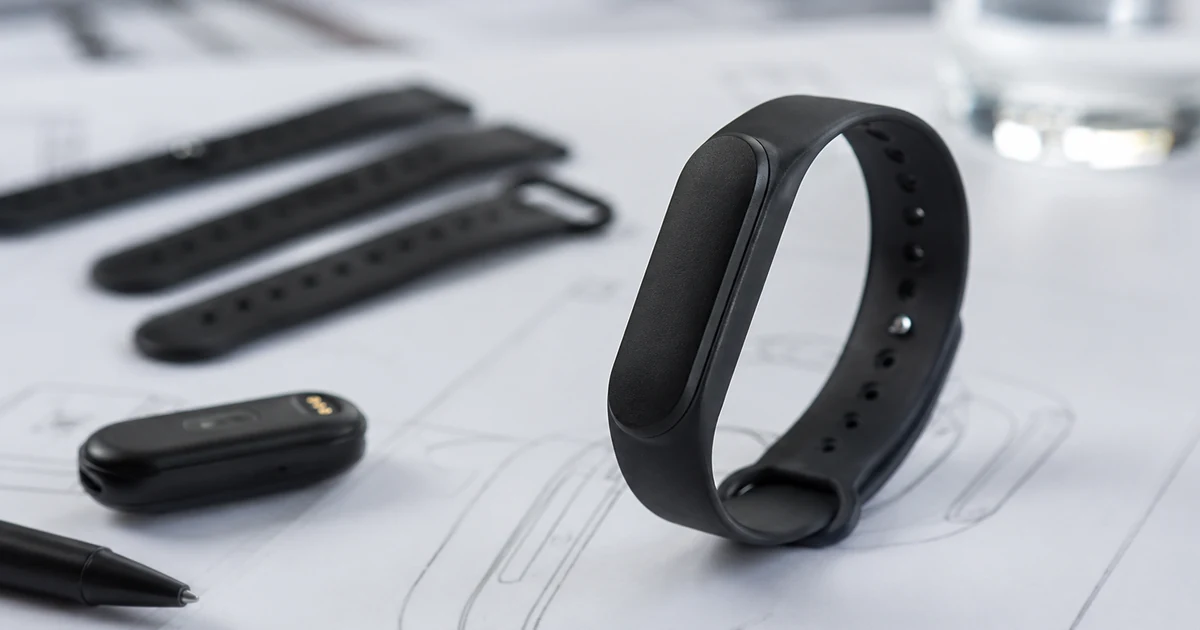
A screenless smart band drops the display and shows every reading in a companion phone app. That single choice extends battery life, lowers the bill of materials, and shifts your product decisions onto four subsystems: the sensor stack, the battery and runtime, the straps and materials, and the app and its data. This guide walks a brand owner through each one, with source-bound examples from Yawell’s five band references, so you can brief a factory and read a quote without trusting numbers that have no test behind them.
TL;DR
- Removing the screen moves all output to the app, which is why screenless bands run for days to weeks.
- Judge a band on four subsystems: sensors, battery, straps, and app integration.
- A waterproof or battery figure is only worth quoting when its test standard and report are named.
- Yawell’s Y24 to Y28C models show the tradeoffs with specs bound to their sheets. Terms are confirmed in a written RFQ.
What screenless actually changes for your product
The screen is the most power-hungry and most expensive part of a normal watch. Take it away and two things happen. Battery life goes up because nothing is lit for most of the day, and unit cost goes down because the display, its driver, and the cover glass leave the build. Everything the user would have read on the wrist now appears in the companion app.
This is a deliberate product class, not a budget compromise. Garmin ships CIRQA, a screen-free health and fitness tracker, which shows that a tier-one brand treats screenless as a design direction rather than a downgrade. For a brand owner, the useful way to think about a screenless band is that you are buying four subsystems and an app, and the screen is simply gone from the cost sheet.
Sensors: what the band can measure and how to trust it
Bands read heart rate, heart rate variability, and blood oxygen with an optical PPG sensor, which shines light into the skin and measures the reflected signal. An accelerometer sits alongside it to track motion and estimate sleep. The sensor part number and its tuning decide which features you can list and how well they hold up.
Accuracy is where quotes get loose. A supplier can print a high accuracy figure with no reference behind it. Ask which sensor part the band uses and whether its heart rate and SpO2 output were checked against a medical-grade reference, because PPG performance depends on the sensor, the firmware, and the fit, not on a slogan.
Yawell’s bands name their sensor parts on each spec sheet. Y24 uses an HX 3918H, Y25 and Y25S use a Vcare VC30F-S, and Y26 and Y28C use an HX 3697. Feature sets differ by model, so read them per SKU rather than assuming the whole line is identical. Y24, Y25S, and Y26 list heart rate and HRV, SpO2, sleep, and stress trends, while Y25 and Y28C list heart rate and sleep only. These are the features the spec sheets state, described as tracking features and not as medical measurements.
Battery and runtime: the main payoff of no screen
Runtime is the clearest reason to choose screenless. With no display draining the cell, a band can run for days or weeks on a charge, and it tops up in about an hour to ninety minutes on a magnetic cable or pad.
Yawell’s runtime figures, taken from the spec sheets, span a wide range. Y25 is the runtime leader at 25 to 30 days of use and about 60 days of standby. Y26 lists 7 to 10 days of use, Y25S lists 10 to 15 days, and Y24 and Y28C list 5 to 7 days. Charge time is about 1.5 hours for most models and about 1 hour for Y26.
There is a tradeoff worth naming for buyers. The longest-running models often carry a smaller sensor set. Y25 reaches 25 to 30 days with a heart rate and sleep feature list, while the models that add SpO2 and stress trends draw more power and post shorter numbers. Match the runtime target to the use case before you lock a sensor stack.
Straps and materials: fit, tooling and customization
The body material and the strap decide how the band feels, how it photographs, and how much of it you can customize. Yawell’s bodies use zinc alloy, transparent polycarbonate, or plastic, and the straps come as elastic, nylon, or silicone depending on the model. Y24 pairs a zinc alloy body with an elastic band, Y25 and Y25S use nylon or nylon and silicone, Y26 uses a transparent PC body with a nylon strap, and Y28C uses a plastic body with a nylon strap.
For a brand, the strap and the body finish are the usual customization levers: color, logo, strap material, and packaging. Tooling for a new strap or a custom body color has its own minimum order and lead time, so raise it early in the brief rather than after the sample is approved. Ask which parts are stock and which need new tooling, because that split drives both cost and schedule.
App integration: the real product on a screenless device
On a screenless band the app is where the user lives, so scope it with the same care as the hardware. There are three levels to settle. The first is the default companion app that ships with the band and shows the readings. The second is SDK or API access, which lets you pull the device data into your own app or cloud instead of the supplier’s app. The third is data ownership: where the health data is stored and who controls it.
White-label wearable programs commonly offer all three, but the depth varies by supplier, and it is easy to assume an SDK exists when only a stock app is on offer. Decide early whether your brand needs its own app and its own data store, because that choice changes the integration work and the contract.
Yawell’s band line uses the QRing companion app. SDK, API, and fully custom app paths are scoped per project, so route those questions into the RFQ. If you are weighing a stock app against building your own, the tradeoffs of cost, control, and time to market deserve their own read before you commit.
Waterproof numbers: read the standard, not the sticker
Water resistance is the claim buyers get wrong most often, because two different ratings get used loosely. ATM, governed by ISO 22810, tests pressure resistance and is quoted in atmospheres. IP, governed by IEC 60529, tests ingress of dust and water and is written as something like IP68. They measure different things, so a band can carry both.
Two facts keep a brand safe. For swimming, the common guidance is 5ATM or IP68 or higher, while 1ATM covers splash and rain only. And an ATM figure is a pressure-equivalent rating, not a guaranteed depth in meters, since time in the water and seal wear reduce real protection. A waterproof number without its standard is marketing, not data.
Yawell states waterproof wording on the spec sheets and nothing beyond it. Y25 lists 1ATM, and Y24, Y25S, Y26, and Y28C list 5ATM. No separate waterproof test report is published for the band line on the site, so the honest way to quote these is as spec-sheet wording, with the 1ATM model positioned for daily wear and splash rather than swimming.
Comparison table: Yawell screenless band references
| Model | Platform | HR sensor | Usage / standby | Charge | Body + strap | Waterproof (spec sheet) | Feature set |
|---|---|---|---|---|---|---|---|
| Y24 | Jieli JL7073A | HX 3918H | 5-7 d / 25 d | ~1.5H magnetic cable | Zinc alloy + elastic | 5ATM (no separate report) | HR/HRV, SpO2, sleep, stress |
| Y25 | Jieli JL7073A | Vcare VC30F-S | 25-30 d / 60 d | ~1.5H magnetic cable | Zinc alloy + nylon | 1ATM (no separate report) | HR, sleep |
| Y25S | Jieli JL7073 | Vcare VC30F-S | 10-15 d / 30 d | ~1.5H magnetic cable | Zinc alloy + nylon/silicone | 5ATM (no separate report) | HR/HRV, SpO2, sleep, stress |
| Y26 | Nordic nRF 54L15 | HX 3697 | 7-10 d / 30 d | ~1H magnetic | Transparent PC + nylon | 5ATM (no separate report) | HR/HRV, SpO2, sleep, stress |
| Y28C | Jieli JL7073 | HX 3697 | 5-7 d / 30 d | ~1.5H magnetic cable | Plastic + nylon | 5ATM (no separate report) | HR, sleep |
Every figure here comes from the model spec sheets. Use it to shortlist a form factor, then request the full sheet and any available test files for the SKUs you care about. You can browse the full line on the Yawell smart bands page.
Sourcing a band program: OEM, ODM or private label
Three sourcing paths set how much you can change. OEM builds to your own design, which gives the most control and the highest tooling cost. ODM adapts an existing reference design such as the Yawell band models, which is faster and cheaper because the hardware is proven. Private label rebrands a stock product with your logo and packaging, which is the quickest route with the least engineering.
Minimum order quantity, tooling cost, and lead time depend on the path, the model, and how much customization you ask for, so they belong in a quote rather than in a blog number. Before any tooling is cut, request the full spec sheet, the sensor part numbers, any waterproof or safety test files, the companion app and SDK options, and a written MOQ and lead time for the exact configuration you want. That list is what turns a rough idea into a comparable quote.
FAQ
What is a screenless smart band?
A wrist band with no display. It carries the sensors and battery, and it shows all readings in a companion phone app, which lowers cost and extends battery life.
How accurate are band sensors?
Accuracy depends on the PPG sensor part, the firmware, and the fit. Ask for the sensor part number and whether heart rate and SpO2 output were verified against a reference, rather than trusting a headline accuracy figure.
What waterproof rating does a band need?
For splash and rain, 1ATM is enough. For swimming, look for 5ATM or IP68 or higher, and confirm the test standard. Yawell’s band sheets list 1ATM for Y25 and 5ATM for the others, with no separate report published.
Can I use my own app instead of the default one?
Sometimes. It depends on whether the supplier offers SDK or API access and how data ownership is handled. Yawell bands ship with the QRing app, and custom app or SDK paths are scoped per project through an RFQ.
What is the minimum order to customize a band?
It varies by model, path, and how much you customize. Send the configuration you want and ask for a written MOQ and lead time.
Ready to spec a band program
Pick two or three models from the table, then send an RFQ with the features, runtime, waterproof level, strap, and app path you need. Yawell replies with the full spec sheets, available test files, and a written MOQ and lead time for your configuration. If you are still weighing a band against a ring, compare them in smart ring vs screenless smart band. Start with the Yawell smart bands line, then open an RFQ to move from shortlist to quote.