
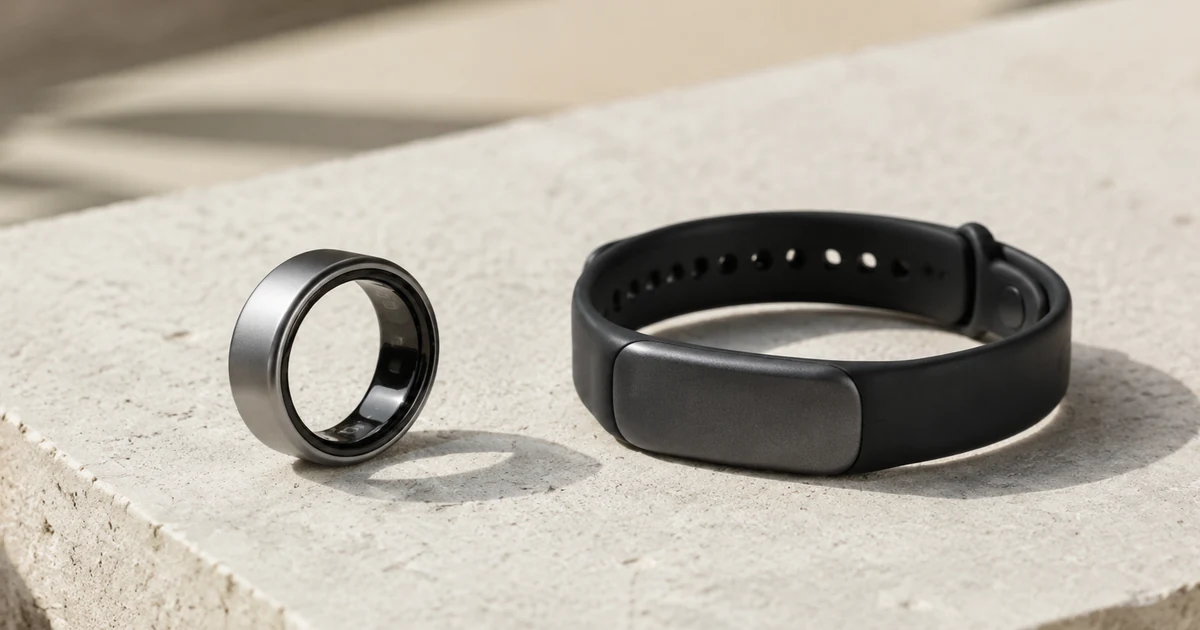
A brand choosing its first wearable often lands on the same question: a smart ring or a screenless band? Both track the same core signals, both skip a big screen, and both can carry your logo. The honest answer is that neither wins outright. The choice is a form-factor decision, and form factor sets sensor placement, battery size, how visible the device is, and what you can customize. This guide compares the two using Yawell’s ring line (R02 to R20) and screenless band line (Y24 to Y28C), with specs bound to their sheets, so you can pick by your user rather than by a supplier’s pitch.
TL;DR
- Both form factors are viable; the choice depends on your user, price point and battery expectation.
- A ring is discreet, premium and small-battery with per-finger sizing.
- A band is more visible, runs longer and lets you swap straps, with a lower bill of materials.
- Both Yawell lines run on the same QRing app. Terms are confirmed in a written RFQ.
The choice is a form-factor decision
A ring sits on the finger and a band sits on the wrist. That one difference cascades. Finger placement keeps the device small and discreet and limits battery volume. Wrist placement gives more surface area for a larger cell and more sensors, and the device is more visible on the body. Neither is better in the abstract. A discreet wellness brand and a visible fitness brand will read the same tradeoffs and reach opposite, correct answers.
So the useful way to run this comparison is by dimension: sensors, battery, materials and customization, waterproof evidence, and cost and positioning. Yawell makes both lines on the same companion app, which is why the comparison below stays concrete instead of taking a side.
Sensors and accuracy: finger vs wrist
Both rings and bands read heart rate, HRV, and blood oxygen with an optical PPG sensor and use an accelerometer for motion and sleep. Where that sensor sits matters. A study that captured PPG from both the finger and the wrist found that sensor location plays a role in signal quality, so form factor shapes capability rather than being cosmetic. That does not make one Yawell product more accurate than another on paper, and this guide makes no such claim; it means placement is a real engineering variable to weigh.
Read features per model in both lines. Yawell rings list heart rate and HRV, SpO2, sleep, and stress across the line, with body temperature and gesture control on several models such as R04S, R10, and R20. Yawell bands vary the same way: Y24, Y25S, and Y26 add SpO2 and stress, while Y25 and Y28C keep to heart rate and sleep. These are the tracking features the spec sheets list, not medical measurements.
Battery and runtime: small cell vs more room
Battery is where the wrist has the clearest edge. A ring has to fit its cell inside a band of metal or ceramic, so runtime is measured in days. Yawell’s R20 titanium ring lists 5 to 7 days of use and about 15 days of standby, which is typical for the form factor. A wrist band has more room, so a screenless band can stretch much further. Yawell’s Y25 band lists 25 to 30 days of use and about 60 days of standby.
Set the runtime expectation against the use case. A premium ring worn all day for sleep and recovery is judged on comfort and discretion, and a multi-day charge cycle is normal. A fitness band aimed at a buyer who dislikes charging is judged on runtime, and the screenless band answers that directly. Charge times are short in both lines, roughly one to one and a half hours on a magnetic connection.
Materials and customization: what you can change
The two form factors give you different customization levers. A ring is a piece of jewelry, so it customizes on material, finish, and sizing. Yawell’s ring line spans stainless steel, a ceramic model (R12), and a titanium model (R20), and each finger size is a separate part. A band customizes on the strap, the body finish, and the packaging. Yawell’s bands use zinc alloy, transparent polycarbonate, or plastic bodies with elastic, nylon, or silicone straps.
That difference changes your tooling conversation. Ring customization tends toward material grade, plating, and the sizing range you stock. Band customization tends toward strap material and color, body color, and box design. Raise whichever levers you need early, because new tooling carries its own minimum order and lead time in both cases.
Waterproof evidence: read it per model
Water resistance is read the same disciplined way in both lines: trust the number only with its standard, and check it per model. On the ring side, evidence differs by SKU. R02 lists 5ATM on its spec and box and has a separate IEC 60529 report that lists IP68 with a pass result. R08 and R10 have 5ATM reports, and R10’s is under ISO 22810. R12 carries two separate report branches, a 5ATM at 50 m report under ISO 22810 and an IP68 at 30 m report under IEC 60529. R04S and R20 carry no waterproof wording, so they should never be described as water resistant.
On the band side, the wording is spec-sheet only. Y25 lists 1ATM, and Y24, Y25S, Y26, and Y28C list 5ATM, with no separate waterproof report published for the band line. For deeper per-model ring detail, see the ring guides; the point for this decision is that both lines are quoted honestly against their own evidence.
Cost and positioning
A ring reads as premium and personal, closer to jewelry, which supports a higher price and a wellness or lifestyle story. A screenless band reads as accessible and practical, and its lower bill of materials leaves room for a broader price point and a fitness story. Removing the screen helps the band on cost, while the ring’s materials and machining push the other way.
The software decision is shared. Both Yawell lines use the QRing companion app, so a brand can run a ring, a band, or both without switching platforms. That makes it reasonable to launch with one form factor and add the other later on the same app.
Comparison table: ring vs screenless band
| Dimension | Smart ring | Screenless band |
|---|---|---|
| Worn on | Finger, discreet and jewelry-like | Wrist, more visible |
| Sensor placement | Finger PPG; location affects signal quality | Wrist PPG; more surface area |
| Battery / runtime | Smaller cell; R20 5-7 d use / 15 d standby | More room; Y25 25-30 d use / 60 d standby |
| Materials | Stainless steel, ceramic, titanium | Zinc alloy, transparent PC, plastic |
| Customization | Material, finish, per-finger sizing | Strap, body finish, packaging |
| Waterproof evidence | Per model; reports on R02/R08/R10/R12; R04S/R20 none | Spec-sheet wording (Y25 1ATM, others 5ATM), no separate report |
| Companion app | QRing | QRing |
| Best fit | Discreet wellness, premium positioning | Visible fitness, long runtime, lower BOM |
Which should your brand pick?
Pick a ring if your user wants a discreet device they can wear all day and to bed, if premium materials and a jewelry feel support your price, and if a multi-day charge cycle is acceptable. The Yawell ring line gives you stainless, ceramic, and titanium options on the QRing app.
Pick a screenless band if your user wants a visible fitness device, if long runtime and infrequent charging matter, if strap variety helps your merchandising, and if a lower bill of materials opens a broader price point. The Yawell band line gives you five screenless references on the same app.
If you are unsure, start with the form factor that matches your lead product story and keep the other open, since both share the QRing app and the same source-bound spec discipline.
FAQ
Is a smart ring better than a screenless band?
Neither is better in general. A ring suits discreet, premium wellness use; a band suits visible fitness use with longer runtime. Choose by your target user and price point.
Which is more accurate?
Both use PPG sensors, and sensor location affects signal quality. Accuracy depends on the sensor part, firmware, and fit in each model, so compare specific SKUs rather than assuming the form factor decides it.
Which lasts longer on a charge?
A screenless band usually runs longer because the wrist allows a bigger battery. Yawell’s Y25 lists 25 to 30 days of use, while a ring like R20 lists 5 to 7 days.
Can I sell both a ring and a band under one app?
Yes. Both Yawell lines use the QRing companion app, so you can launch one and add the other without changing platforms.
What can I customize on each?
Rings customize on material, finish, and sizing. Bands customize on strap, body finish, and packaging. Send your configuration for a written MOQ and lead time.
Ready to choose a form factor
Decide which story fits your brand, then send an RFQ with the form factor, features, runtime, and customization you want. Yawell replies with the full spec sheets, available test files, and a written MOQ and lead time. Compare the Yawell smart ring and Yawell smart bands lines, read the screenless smart band OEM guide for band detail, then open an RFQ.