
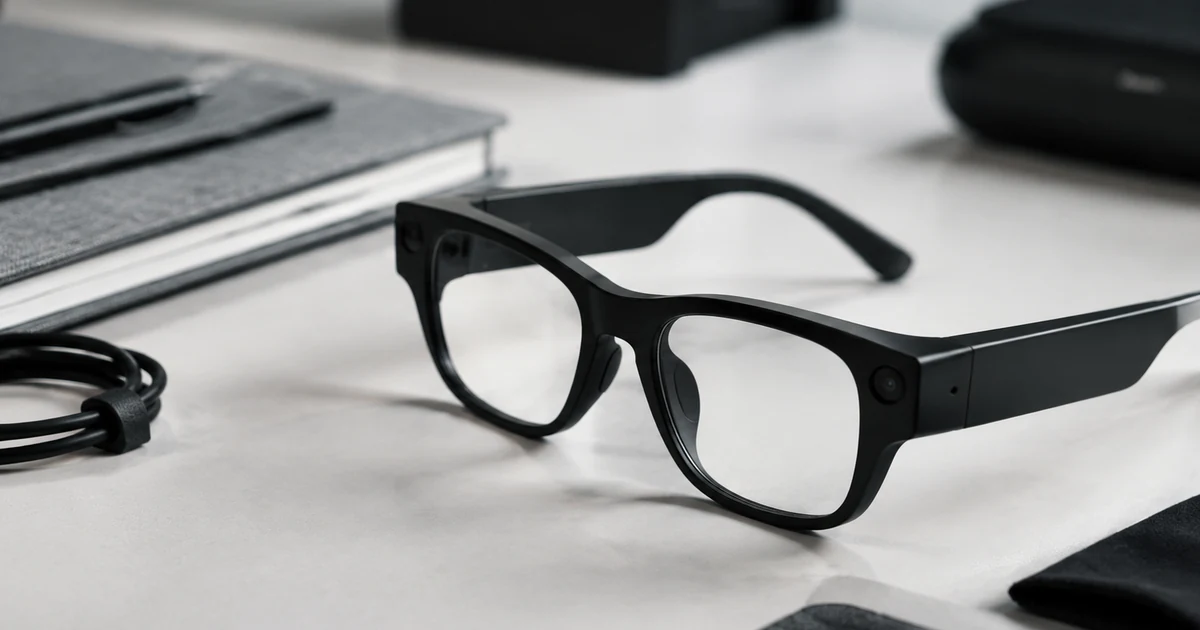
AI camera glasses put a camera, microphones, and speakers on a person’s face and add AI features like translation and an assistant through a phone app. That makes them one of the most interesting wearable categories to launch and one of the riskiest to source, because a camera-and-mic device carries duties a ring or a band never does. This guide walks a brand through the five things that decide a camera-glasses program: the camera, the battery, the translation and AI, the audio, and compliance. It uses the Yawell A2C as a concrete, source-bound example, with every number taken from its spec sheet.
TL;DR
- Evaluate camera glasses across five subsystems: camera, battery, translation, audio, and compliance.
- Compliance is the one most first-time buyers underestimate, because a recording device raises privacy-law duties and needs certification per market.
- The Yawell A2C runs on Allwinner V821 with an 8 MP Sony IMX 219 camera and the HeyCyan app.
- Terms are confirmed in a written RFQ.
AI camera glasses are a real category now
This is no longer a concept product. Meta’s Ray-Ban style AI glasses launched around $299 in 2026, which sets the buyer’s baseline for what a camera-and-mic wearable should do: capture photos and short video, take calls, play audio, and run AI features through an app. A brand entering the category is judged against that bar, so the sourcing job is to match the experience while owning the risks that come with a camera on the face.
The useful way to run the evaluation is subsystem by subsystem. Four of them are familiar hardware and software questions. The fifth, compliance, is where camera glasses differ from every other wearable.
Camera: verify the sensor, not the resolution
A megapixel count on a spec sheet tells you little on its own. Image quality on glasses depends on the sensor, the lens, and the platform’s image processing together. Ask which sensor the glasses use and request sample footage in real light, because a named sensor and real samples beat a headline resolution.
The Yawell A2C uses an 8 MP Sony IMX 219 camera on an Allwinner V821 processor paired with a Jieli JL7018F. Naming the sensor part is the point: it lets a buyer check the sensor’s known behavior and compare it against other quotes on the same basis rather than on marketing numbers.
Battery: read it against the camera and call load
Battery is the spec suppliers present most optimistically, because idle standby looks impressive and says nothing about real use. A camera and a live call drain a small glasses battery far faster than standby. Read the runtime figures that match how the product is used, and ask how long the glasses record video and hold a call on a charge.
The A2C spec sheet lists 10 hours of continuous call time and 5 to 7 days of standby, with Type-C charging in about 1.5 hours. Those are useful because they separate the working number, call time, from the idle number, standby. Ask any supplier to quote both, and to state the test basis behind them.
Audio: microphones and open-ear sound
Camera glasses handle calls and music with open-ear speakers that sit near the ear and a microphone array that captures the wearer’s voice while cutting wind and background noise. Audio quality decides whether the calling and assistant features are usable in the real world, so it deserves the same scrutiny as the camera.
The A2C lists Bluetooth calling, music playback, and dual-mic noise cancellation on its spec sheet. When you evaluate a sample, test a call outdoors and in a noisy room, because that is where a weak mic array shows up.
Translation and AI: the app is the product
The AI features are where camera glasses earn their name, and they run through the companion app and its cloud services rather than fully on the device. Translation, the AI assistant, and media are software you scope like hardware, because their quality, languages, and data handling live in the app.
The A2C uses the HeyCyan app for shooting, AI translation, the AI assistant, calling, and media. Since the app carries so much of the product, decide early how much of it you want to own or customize. That is a separate decision with its own cost and control tradeoffs, covered in the white-label versus custom app guide.
Compliance: the duty most buyers underestimate
A camera on the face changes the legal picture, and this is the section first-time buyers skip at their peril. Three areas need a plan before you launch.
The first is recording privacy. Recording other people, especially audio, is regulated, and the rules vary. In the United States, states split between one-party consent, where one participant may record, and all-party consent, where everyone must agree, and wiretapping-style laws can apply to audio. Rules differ by country as well, and some venues such as schools, casinos, and workplaces restrict smart glasses regardless of the law. This guide is general information and not legal advice, so get local counsel for each market you sell into.
The second is the recording indicator. A visible light that shows the camera is on is becoming both an expectation and a legal proposal, with proposed laws that would require a recording light. Meta went as far as making its glasses disable the camera if the recording light is tampered with. Plan for a clear indicator in your industrial design rather than treating it as optional.
The third is certification. Selling a wireless consumer electronic generally requires market certifications: FCC in the United States, CE in the European Union, and safety marks such as UL, along with radio and electromagnetic testing for the Bluetooth radio. Requirements differ by market, so confirm the plan for each region with your factory. Ask what testing is done and what documentation you receive, and route the specific certification status of any Yawell model to an RFQ rather than assuming a mark is in place.
A2C spec sheet
| Subsystem | A2C spec | Buyer check |
|---|---|---|
| Platform | Allwinner V821 + Jieli JL7018F | Confirm the SoC and co-processor parts |
| Camera | 8 MP Sony IMX 219 | Verify the sensor part, not just a resolution number |
| Battery / charge | Type-C, ~1.5H charge, 10H continuous call, 5-7 d standby | Read runtime against camera and call load, not idle |
| Audio | Bluetooth calling, music, dual-mic noise cancellation | Check the mic array and open-ear speaker quality |
| AI features | Shooting/video, AI translation, AI assistant via HeyCyan app | Scope the app and cloud like the hardware |
| Frame | Super Tough PC | Confirm fit, weight, and finish options |
| Waterproof | Not listed | No waterproof claim; do not assume a rating |
Every figure here comes from the A2C spec sheet. The waterproof row is deliberate: the A2C does not list a waterproof rating, so no water-resistance claim should be made for it.
Sourcing a glasses program
The paths are the same as any wearable: OEM builds to your design, ODM adapts a reference such as the A2C, and private label rebrands a stock product. Camera glasses add a few sourcing requests on top of the usual ones. Ask for the camera sensor part and sample footage, the battery test basis for camera and call use, the microphone array design, the app and translation scope, and the certification plan for your target markets.
Minimum order quantity, tooling, and lead time depend on the model and how much you customize, so they belong in a quote. Send the configuration and the markets you plan to sell in, and ask for a written scope that includes the compliance support you will get.
FAQ
Are AI camera glasses legal to sell?
Yes, the products are legal to sell, but how they may be used to record others is regulated and varies by region. Plan for recording-consent law and a visible recording indicator, and get local legal advice for each market.
Do smart glasses need a recording light?
A visible recording indicator is expected, and some proposed laws would require one. Meta already disables its camera if the light is tampered with. Design in a clear indicator.
What certification do smart glasses need?
A wireless device generally needs FCC in the US, CE in the EU, and safety marks such as UL, plus radio and EMC testing, with requirements differing by market. Confirm the plan per region with your factory.
What can the A2C camera do?
The A2C lists an 8 MP Sony IMX 219 camera for shooting and video, with AI translation, an AI assistant, Bluetooth calling, music, and dual-mic noise cancellation through the HeyCyan app.
What app do the glasses use?
The A2C uses the HeyCyan app for shooting, translation, the assistant, calls, and media.
Ready to scope a glasses program
Decide your target markets and the camera, audio, and AI features you need, then send an RFQ with the configuration and the regions you will sell in. Yawell replies with the A2C spec detail, the app scope, and the compliance support for your plan. To see how much of the product you can change, read how to customize AI smart glasses, and to decide how much of the app to own, read the white-label vs custom wearable app guide. The Yawell A2C smart glasses page has the reference model, then open an RFQ.