
TL;DR
- Evaluate the stack: SoC/MCU, sensor, charging, firmware branch, companion app support for one model ID.
- Yawell publishes platform notes per model. R02 has dual chip branches that must not be merged in claims.
- Sensors are not medical devices by default. Ask for part numbers and validation method; avoid “medical-grade” marketing without evidence.
What “Platform” Means in a Ring RFQ
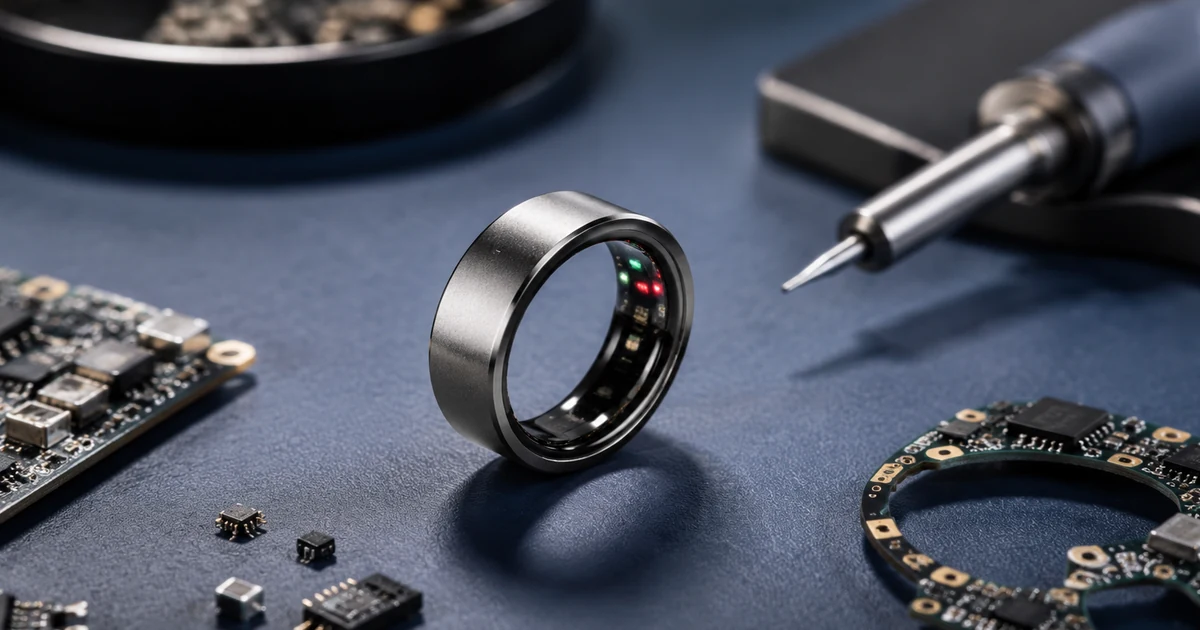
A smart ring platform is more than a metal shell. Buyers should freeze:
- Wireless SoC / MCU family
- Heart-rate / SpO2 style PPG sensor part
- Charging method
- Firmware branch and OTA expectation
- App path (QRing for rings on Yawell’s public routing)
Changing one block can force re-test, re-certification discussion, and new samples.
Example Public Platform Notes (Not a Full BOM)
| Model | Public platform note | Buyer check |
|---|---|---|
| R02 | Dual source branches: Realtek RTL8762 ESF / BlueX RF03 | Do not merge branches in claims or quotes |
| R04S | Jieli JL7073 + Vcare VC30F-S (public blurb) | Feature model; no water claim on site |
| R08 / R10 | RTL8762 ESF stainless lines | Charging differs (magnetic compartment vs wireless dock) |
| R12 | Ceramic model with dual water report branches | Keep water evidence separate from chip talk |
| R20 | Nordic nRF54L15 + GOODiX GH3026 titanium | No public water report |
Always re-open the model page before you write a datasheet for a brand: ring line.
Chipset Questions That Belong in the RFQ
- Exact module or chipset revision for the mass-production branch
- Bluetooth feature needs and target phone OS matrix
- Power budget and expected wear profile
- OTA support and who signs firmware images
- Whether a pre-certified module path exists for your markets
Nordic’s nRF54L family is positioned as a newer BLE SoC generation relative to nRF52/nRF53 lines in vendor technical comparisons (Ezurio nRF54 vs nRF53 vs nRF52 overview). Nordic has also publicized smart-ring products integrating nRF54L15. That is industry adoption context, not a claim that one chip always wins for every brand brief. Match capability, supply, power, and certification path to the product plan.
Certification reuse is a cost and schedule driver (cost drivers).
Sensor Questions That Belong in the RFQ
- Sensor part number on the frozen BOM
- Which metrics the firmware actually exposes
- Any validation method or report (if you need one)
- What the app will display vs what packaging may claim
Peer-reviewed work on wearable optical heart-rate sensors documents multiple inaccuracy sources (motion, fit, skin tone, ambient light, algorithms) and warns against treating consumer PPG as automatically clinical-grade (e.g. literature summarized in PMC7010823 and related reviews). Keep public language wellness-bounded and source-bound (buyer checklist).
Red Flags
- One sensor claim applied to every model
- “Medical-grade” with no part number or method
- Quote that ignores R02 dual-branch selection
- App metrics promised without firmware support
- Water claims mixed into chipset discussion without model PDFs
Evaluation Table for Supplier Calls
| Topic | Ask for | Acceptable evidence |
|---|---|---|
| SoC | Part / module on BOM | BOM line + datasheet under NDA |
| Sensor | Part number | BOM line + any validation note |
| Firmware | Branch ID + OTA path | Written scope |
| App | Fields available to brand | SDK/docs discussion |
| Cert path | Existing IDs for exact model | FCC/SIG/CE docs when available |
FAQ
1. Should I always pick the newest Nordic chip?
Only if the product brief needs it. Match capability, cost, supply, and certification path to the brand plan.
2. Can I swap sensors on an ODM ring freely?
Usually not freely. Sensor changes affect firmware, mechanics, power, and claims.
3. Where do I see Yawell model differences?
On each model page and the ring category page. Keep statements source-bound.
Next Step
Freeze model ID, chip branch (if dual), sensor expectation, and app metrics list in one RFQ.
Request a quote. Related: app customization, materials, OEM/ODM service.