
Your customer cannot try a smart ring on before buying it. That one fact turns sizing from a detail on the packaging spec into a program you have to fund, stock and operate. Most brand owners discover this after the first shipment, when returns arrive and the cost is already spent. This guide covers the four sizing decisions that carry money, what actually causes size returns, and why ring size changes the product itself rather than only the fit.
TL;DR
- Sizing is a program with its own budget, decided before tooling or paid for afterwards in returns.
- A sizing kit is a second physical product with its own bill of materials, packaging and shipping leg.
- Smart ring sizes do not match jewelry sizes, and they do not always match each other or even earlier generations of the same brand.
- Internal volume differs by size, so battery capacity differs, and a loose fit degrades optical sensor data.
Sizing is a program, and it has a budget
A customer buying shoes online knows their size from every other pair they own. A customer buying a smart ring often has no reliable reference, because the size they remember comes from jewelry and does not apply here. The brand has to manufacture that certainty and ship it to them.
Four decisions carry cost. Each one gets settled before tooling or gets paid for later in returns.
| Decision | Cost driver | Question for your supplier |
|---|---|---|
| How wide a size range to stock | Every added size multiplies inventory across the whole range | What size range do you tool, and what does adding a size at each end cost? |
| Whether to ship a sizing kit | A second physical product with its own BOM, packaging and shipping leg | Do you supply sizing kits, can they carry our brand, and what is the per-unit cost? |
| How to write size guidance per market | Localisation work, and returns if skipped | Can you provide inner circumference in millimetres for every size? |
| How to allocate stock across sizes | Working capital stranded in the wrong sizes | Can we split a production run across sizes, and what is the minimum per size? |
None of these appear on a standard quotation. You have to raise them.
Smart ring sizes are their own system
The assumption that sinks first-time programs is that a ring size is a ring size. The brands with the most experience in this category say otherwise on their own sizing pages. RingConn tells buyers directly that its ring sizes are different from regular ring sizes. Ultrahuman goes further and states that its sizes differ from standard market sizes and from other smart rings.
The reason is physical. A jewelry band is a shaped piece of metal. A smart ring carries a battery, a sensor package and a rigid shell around them, so wall thickness and interior geometry are set by what has to fit inside. Two rings with the same nominal size can wear differently because their interiors are shaped differently.
That also means sizing does not travel across product generations. Oura Ring 5 is available in sizes 6 to 13, while Oura Ring 4 ran from size 4 to 15, and Oura states that Ring 5’s redesigned interior fits differently from Ring 4. An existing owner upgrading has to size again. If you plan a second generation, plan for that conversation with your installed base.
For reference, the Yawell ring line covers US sizes 6 to 13, eight sizes. That figure is confirmed by the factory rather than printed on a published spec sheet, which is a distinction this article returns to later.
The sizing kit is a product, so treat it like one
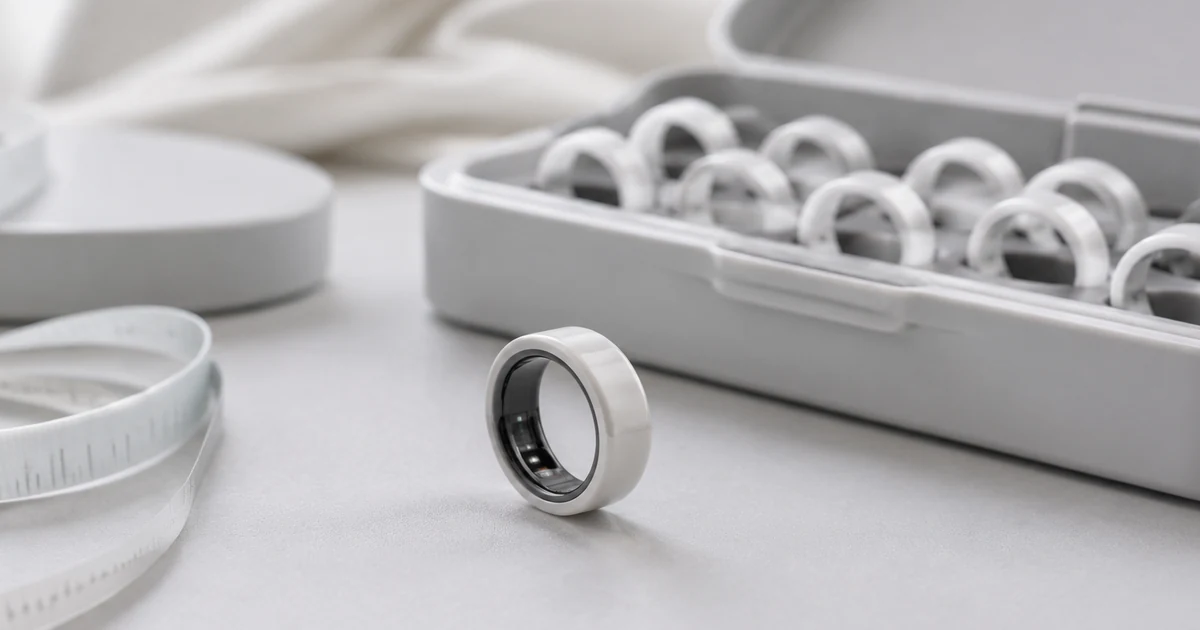
A sizing kit is a set of non-functional sample rings that ships to the customer before the real product. It exists so the customer wears each candidate size on the finger they intend to use, and confirms fit before anything is dispatched or built.
Two public examples show the shape of the commitment. RingConn offers a free sizing kit that ships before the ring, with delivery quoted at 3 to 8 days depending on location. The Ultrahuman kit contains ten sample rings.
Read those as cost lines rather than as marketing. A kit means tooling or sourcing for the sample rings, packaging for the set, an extra outbound shipping leg per customer, and a delay between the first order and the revenue-generating shipment. It also means a return path decision, since some brands ask for the kit back and some write it off.
The kit is also a branding decision. Yawell’s sizing kits can be customized with the buyer’s brand, which changes what the kit is. A plain plastic set is a tool. A branded set is the first physical object your customer holds with your name on it, arriving days before the product itself. Those are different products at different costs, and the choice belongs in the launch plan rather than in a later revision. The same discipline applies to order quantities, which the guide to MOQ, samples and lead time covers in detail.
Ring size does not travel between markets
Ring sizing is not one system. ISO 8653:2016 defines standard ring sizes by the inner circumference of the ring in millimetres, and ISO sizes are used in Austria, France, Belgium, the Nordic countries and other parts of continental Europe. The United States, Canada and Mexico use a separate numbering system. A customer converting between them, or a brand publishing one chart globally, introduces error at exactly the point where error is most expensive.
There is a straightforward fix. Inner circumference in millimetres is the one expression of ring size that survives crossing a border, because it is a physical measurement rather than a label. Publish it alongside whatever local size number you use, for every size you sell. If your supplier cannot give you that figure per size, ask why.
Customers reach for whatever tool is nearest. Ring sizes can be measured with a paper, plastic or metal ring sizer, or by measuring the inner diameter of a ring that already fits. The second method is the one that quietly produces wrong answers on smart rings, because the reference ring has a different interior shape.
What actually causes size returns
The four patterns below are what this factory has observed across customer programs. They are not a survey, and no return rate figure appears in this article, because the published benchmarks for this category do not state their methodology and an article about unlabelled numbers should not quote one.
| Root cause | What happens | Prevention |
|---|---|---|
| Sold without a sizing kit | Customers guess from a jewelry size they remember, and smart ring sizing does not match jewelry sizing | Budget the kit as a product from the start, and gate the first order behind it |
| Finger circumference is not stable | A single measurement taken at the wrong time of day or in the wrong temperature produces a size that fails in daily wear | Tell customers to wear the sample size for a full day and night before confirming |
| Size chart did not match local convention | Buyers in a market using a different sizing system convert incorrectly and order the wrong size | Publish inner circumference in millimetres alongside the local size label for each market you sell into |
| Stock allocated by guesswork | Popular sizes sell out while unpopular sizes sit in inventory, so the range is technically in stock and commercially unavailable | Use sizing kit results as demand data before committing the second production run |
Two of these deserve more than a table row.
Finger circumference moves. It changes with temperature and across the day, which means a customer who measures once, at the wrong moment, gets a number that fails in normal wear. A ring that fits at a desk in the afternoon can be tight after exercise or in heat, and loose on a cold morning. This is why the instruction that matters is to wear rather than to measure. A sample size worn through a full day and a night, including sleep, tests the size against the range of conditions the real product will meet.
Stock allocation is the failure that hurts most and gets noticed least. A brand orders its production run split evenly across the range, or split by a guess, and then finds the middle sizes gone within weeks while the ends sit in the warehouse. On paper the product is in stock. Commercially it is unavailable to most of the people who want it, and the working capital is frozen in the sizes nobody ordered. Sizing kit requests are demand data arriving before the sale, so read them before committing the second run.
The cost of a single size return is worth stating even without a percentage. It carries outbound shipping, return shipping, inspection of a worn product, and usually a replacement unit, against a margin that was calculated on one shipment.
Size changes the product, not only the fit
Two effects make ring size a product decision rather than a checkout decision.
The first is battery. Internal volume differs across sizes, so a smaller ring carries a smaller cell and runs for less time than a larger one in the same model. The size of that difference is not something this article can quantify, because per-size runtime figures do not exist in the category.
Which raises the point behind it. Published runtime figures on smart ring spec sheets generally do not state which ring size they were measured on. That includes the model data published on this site. A buyer comparing a five day figure from one supplier against a seven day figure from another may be comparing two different sizes, and neither sheet says so.
The useful response is a question you should put to every supplier, this one included: which size was that runtime measured on, and does the smallest size in the range still support the claim you plan to print on the box? A supplier who can answer has measured across the range. A supplier who cannot has measured once.
The second effect is data quality. Ultrahuman states that the optical heart rate sensors on the inside of its ring require snug contact with the skin, and that a loose fit can allow light to affect the accuracy of those readings and lead to gaps in the data. A ring that is one size too large does not simply feel loose. It degrades the measurements the entire product is sold on, and the customer experiences that as a product that does not work rather than as a sizing mistake. The chipsets and sensors guide covers what those sensors need from the hardware around them.
Questions to settle before tooling
Take the four questions from the table above into your next supplier conversation, and add three more.
Ask whether a production run can be split across sizes, and what the minimum quantity per size is, because that number decides whether you can respond to real demand or have to commit to a guess. Ask for inner circumference in millimetres for every size in the range, so your size guidance works in every market you sell into. Ask which size each published performance figure was measured on.
Then bring the same discipline to inspection. Sample rings and production rings both need dimensional checks, and the quality control checklist covers what to specify.
FAQ
Are smart ring sizes the same as jewelry ring sizes? No. RingConn and Ultrahuman both state on their own sizing pages that their sizes differ from regular ring sizes, and Ultrahuman adds that its sizes differ from other smart rings. A smart ring’s interior is shaped around a battery and sensors, so the fit differs even at the same nominal size.
What size range should a brand stock? Wide enough to serve your market and narrow enough to fund. The Yawell ring line covers US 6 to 13, which is eight sizes to stock, package and forecast. Every size you add multiplies inventory across the whole range, so treat range width as a working capital decision.
Do I have to ship a sizing kit? Selling without one is the most common cause of size returns this factory has seen. Established brands in the category ship kits before the ring, and RingConn quotes 3 to 8 days for kit delivery depending on location. If you skip it, price the returns you are choosing instead.
What finger should a smart ring be worn on? Whichever finger the customer sizes for and intends to keep using, since sizing is per finger. The practical instruction is to pick the finger first, then wear the sample size on that finger for a full day and night before confirming.
Does ring size affect battery life? Yes. Smaller sizes have less internal volume and carry a smaller cell, so runtime is shorter than in larger sizes of the same model. Ask any supplier which size their published runtime figure was measured on, because most sheets in this category do not say.
How long does a sizing kit add to fulfilment? It adds a full shipping leg plus the time the customer takes to decide. RingConn quotes 3 to 8 days for kit delivery depending on location, and the ring ships after the customer confirms. Build that into your delivery promise rather than discovering it in support tickets.
Get your size range and kit specified
Sizing questions are cheapest to answer before tooling. Send the markets you plan to sell into and any expectation you have about size distribution, and Yawell will come back with the size range, sizing kit specification and branding options, inner circumference per size, and per-size production minimums.
Start with the Yawell smart ring line for the platform specs, then request a quote with your target markets attached.